
Creature Feature: The Smells of Spring
Written by Zachory Mork, naturalist
As we begin to approach the spring equinox, the seasons transition from ice and snow, to rain and buds. As more and more wildlife begin to reemerge, the scents and smells of nature rise in the air to bring a sense of what is already happening in nature, while also serving as a sign of what's to come. Some examples can be the smell of pine trees, wildflowers, and other pleasantries. The creatures highlighted in this month’s Creature Feature also significantly contribute to the smells of nature, but in a way that isn't exactly sunshine and rainbows. So let us dive into some examples of creatures that are known for their odor.
Striped Skunk (Mephitis mephitis)
Let us showcase what likely is the most commonly referenced stinky creature. Striped skunks are part of the Mephitidae family of animals, of which there are sixteen members. In the past, they were originally thought to be more closely related to weasels (the Mustelidae family), but advances in genetics and DNA in the 1990s caused skunks to separate and become their own family of organisms. It is not uncommon to see these skunks at this time of year, as late winter/early spring marks their mating season, with kits arriving roughly two months after gestation begins.
Like humans, a striped skunk is a plantigrade - they walk about using the entirety of their foot, as opposed to just their toes (e.g. cats and dogs) or their tips (e.g. cows and horses). They spend most of their time wandering through a variety of habitats, looking for insects and other small invertebrates to eat. If threatened, the striped skunk contains a pair of powerful scent glands on the rear that store chemicals known as thiols, and they may release these foul-smelling chemicals as far as several meters toward the threat. In some cases, striped skunks may end up spraying each other, which results in a double whammy.
Eastern Musk Turtle (Sternotherus odoratus)
The musk turtle, also known as the stinkpot, is a small, native turtle that spends most of its time in slow moving rivers, ponds, and small lakes that are filled with aquatic vegetation. They are more adapted to crawling along the water’s bottom as opposed to swimming, but that does not mean that they won’t come out of the water to bask or look for a mate. Mating season occurs in the spring, with some areas being as early as March. The incubation of their eggs lasts for a few months, and the factor that determines if the clutch of eggs will turn out to be male or female depends on the temperature of the incubation, with females developing at higher temperatures than males.
In habitats with murky water, a musk turtle may rely on their barbels. These are a sort of sensory organ scattered around their chin and throat, which aid in detecting food or things around their environment. For defence, a musky chemical can be released from their underside. Additionally, a musk turtle has a flexible neck that allows its head to extend close to their hind feet. Therefore, it is not afraid to bite a potential threat if the threat is undeterred by the musk that was released.
Brown Stink Bug (Halyomorpha halys)
Our last creature of the month is another example that probably needs no introduction. Stink bugs are a part of the Hemiptera order of insects. In other words, those that are considered ‘true bugs’. Insects under the Hemiptera order (e.g. cicadas and aphids) generally feed on the sap of plants, and stink bugs are no exception. Feeding begins later in the summer, and favors plants and trees that bear fruit, oftentimes the same fruit plants that humans gather in mass, such as those found in an orchard.
This particular stink bug is a non-native from east Asia that was introduced to the United States in the late 1990s, and has since spread across much of the country. In some cases, they have created destruction throughout places of agricultural importance. Like the other examples mentioned previously, a stink bug can emit an odor from openings in its thorax as a defence mechanism to protect itself from being eaten by predators.
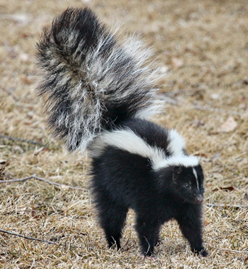
Striped skunk
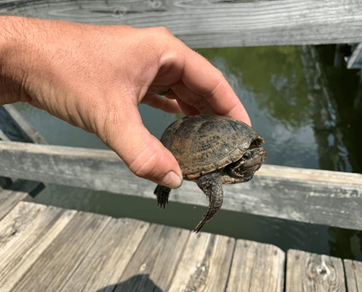
Musk turtle

Brown stink bug