
Creature Feature: Polar Plungers
As we traverse through winter, many opportunities present themselves that are mostly exclusive to this time of year. Common activities may include skiing, fort-building, and sledding to name a few. One option that is also winter-dependent is the idea of a “polar plunge”. This is an event where individuals bravely jump into an exposed body of water at winter temperatures. I, myself, have not performed one of these dips. I had my fill during my days as a youth in summer camp, where at some point we’d get summoned at about seven in the morning to jump into the camp lake, which as a kid seemed cold enough to want to only do once, and call it good.
Reflecting on activities such as these has reminded me that in nature, there are some mammals that not only tolerate the winter months, but also regularly swim in the frigid waters without issue as the winter season progresses. Therefore, in this edition of Creature Feature, we shall be investigating some of the mammals that laugh in the face of hypothermia.
North American Beaver (Castor canadensis)
Our first creature has the title and honor of being the largest rodent in North America! Beavers are famous for being a popular example of a keystone species; a species that plays a significant role and impact within their ecosystem. Due to their habit of creating dams of various sizes, beavers can quite literally build an entire ecosystem as the land slowly transforms into a wetland. While constantly-growing incisors and a paddle-like tail are unique traits to the beaver, it is their fur coat that has the secret to their survival in winter. Beaver coats have two layers of fur that helps them survive cold waters: an inner layer to retain heat, and a longer outer layer designed to be waterproof. The key to being waterproof comes in the form of scent glands that produce an oily substance known as castoreum, and the beaver will spread this castoreum oil along their outer coat to produce that waterproof effect.
Muskrat (Ondatra zibethicus)
Our next creature has an appearance that makes itself look like a cross between a beaver, and a rat. A member of the Cricetidae family (which includes hamsters, lemmings, and North American mice), the muskrat has a scaly, rat-like tail. This tail, combined with their webbed feet, is used to help move and navigate through the water. Mainly herbivorous, muskrats feed on aquatic and wetland-based plants, and are capable of producing multiple litters in a given year. A high muskrat population within a single wetland has the potential to alter the plant diversity of that habitat. They do this by selectively consuming particular plants, such as cattails or water lilies. To balance this, the muskrat is prey to many species, such as larger mammals, reptiles, and birds of prey. To avoid these predators, they have the ability to hold their breath for approximately 15 minutes, despite their small size!
North American River Otter (Lontra canadensis)
Our last feature of the month is the curious and playful river otter! River otters are members of the weasel family Mustelidae, which prey mostly on fish, mollusks, and amphibians. In addition to being nimble and agile, the otter had other helpful adaptations to help them navigate and hunt while underwater. One is that the otters possess long whiskers, which helps them detect prey if the water is dark or murky. Additionally, otters have a third eyelid known as a nictitating membrane. This transparent eyelid prevents water from making contact with the eyes themselves, similar to how swim goggles allow us to keep our eyes open underwater. In actuality, all three examples today have this ability, allowing them to live a comfortable semiaquatic life. Unlike beavers that make lodges, homes for river otters come in the form of burrowed dens that lie near the banks and edges of rivers, lakes, and other wetlands.
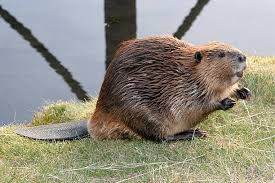
American beaver
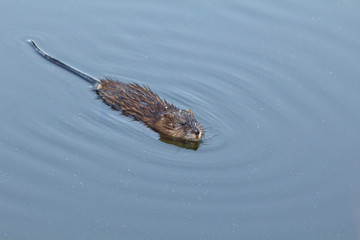
Muskrat
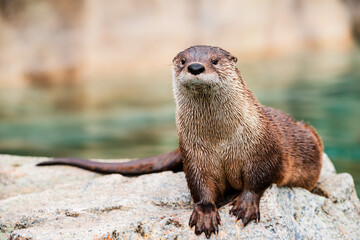
American river otter