
Creature Feature: Home Makeover - Bird Edition
Written by: Zachary Mork, naturalist
With warmer weather well underway, countless birds of many species are returning north to their spring breeding grounds. It is an exciting time for birders of all backgrounds, who go out onto the trails on any given day to seek out birds that are passing through during spring migration. For those whose destination is a place such as Michigan their migration may have already been completed, and are in the process of nest building to raise their young. In this edition of Creature Feature, we will be going over a few examples of spring birds, and describing what their nests look like. Keep an observant eye out for the birds and their nests the next time you are on a nature hike!
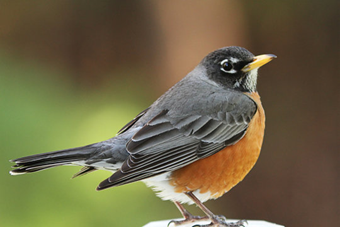
American robin
American Robin (Turdus migratorius)
One of the most common birds found throughout North America, the American robin is a type of thrush that is famous for their red-orange feathers located on their breast.
Considered to be one of the first bird species to breed in the spring, robins build their nest in the shape of a cup, layering the nest with grasses and twigs while also adding mud, which hardens the nest and keeps it intact. Eggs are a bright blue color, and it takes approximately two weeks for the female to incubate the eggs to hatch. Studies have shown that a robin has the ability to hunt for worms using their sense of hearing. This, combined with their sense of sight, is how they seek out invertebrates, which makes up almost half their diet (the other half being berries). So long as these food sources are available, a robin may remain in the contiguous United States year-round. Birds that breed in Alaska and Canada will more likely migrate to where more food is available.
Baltimore Oriole (Icterus galbula)
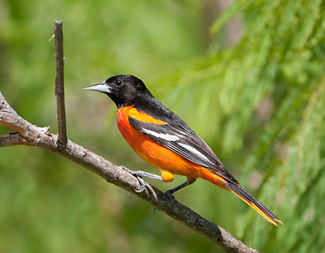
Baltimore oriole
Our next feature is named after a 17th century English politician, whose coat-of-arms matches with the coloration of this bird. The Baltimore oriole is a blackbird that is described as having a yellow-orange breast, black head, and black and white wings. They breed in the eastern side of North America, but migrate to Central America or parts adjacent to for winter. When a female decides on a tree to build her nest, she weaves together a pouch made of grasses that hangs at the end of a tree branch. Inside of the tightly woven pouch, the oriole will lay several eggs, which, like the American robin, takes about two weeks to hatch. Insects, and ripe berries make up most of the Baltimore orioles diet, and they are also an important predator to a moth species that some may consider to be a nuisance.
Downy Woodpecker (Dryobates pubescens)
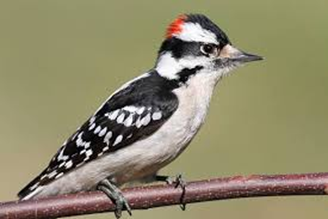
Downy Woodpecker
Our last feature prefers to excavate a home, as opposed to building. The downy woodpecker is North America’s smallest woodpecker species, and dwells in forested areas throughout North America, using its pointed beak to seek out insects for food. It takes a few weeks for a downy woodpecker to finish excavating a nest. During the process, a male will spend approximately half of the day working on the cavity, in small time intervals of approximately twenty minutes at a time. When the female has laid her eggs, both parents take turns laying on them, which are white in color. Appearance wise, they are very similar to another woodpecker species: the hairy woodpecker (Leuconotopicus villosus). However, the downy woodpecker is significantly smaller and the two species are not closely related to each other, making it a bit of a mystery that involves the topic of convergent evolution, where two different species develop similar characteristics over time.