
Creature Feature: Clear as Mud
Written by: Zachary Mork, naturalist guide
One of the surest signs that the spring season is well underway is with the frequent showers of rain that descend from the clouds and sky. Depending on the soil and terrain, this rainwater can mix with the earth, resulting in the creation of mud. In some habitats, mud can be prevalent even without the presence of rain. Within a wetland, for example, where the main water source is largely responsible for the creation and presence of muddy surfaces and substrates. Although it can be a bit of a mess, mud can and is an important ecological component for several different creatures. As we prepare to observe more mud going into the remainder of spring, this month’s Creature Feature all involves animals that not only rely on mud to survive, but also quite literally have mud in their names.
Common Mudpuppy (Necturus maculosus)
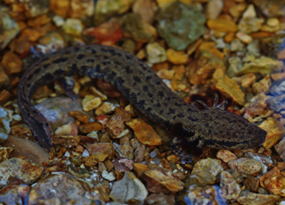
Common mudpuppy
Our first creature is a special type of salamander that lives a fully aquatic lifestyle. Common mudpuppies are found throughout much of the midwestern United States, within lakes, rivers, and ponds. As amphibians, they have the ability to breathe through their skin. However, due to living fully underwater, the need for additional oxygen has allowed mudpuppies to have a set of external gills that further assists in the exchange of gases. Like other salamanders, mudpuppies are pretty secretive. Most are nocturnal, but if they are active during the day, they will likely be hidden in muddy, murky waters so they are not visible to potential predators such as larger fish, herons, or otters. Food involves eating creatures of many sorts, including worms, mollusks, and insects. It takes approximately six years for a mudpuppy to mature to adulthood, and have an average lifespan of eleven years in the wild.
Mud Dauber Wasp (Sphecidae family)
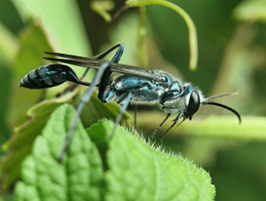
Blue mud dauber
Mud daubers are a group of wasps that mainly belong to the Sphecidae Family of insects. They are famous for their thread-like waists, and their habits of shaping nests out of mud through the use of their mandibles - a pair of small appendages near the mouth of the insects. Additionally, mud daubers are known as a parasitoid - a parasite that is so closely involved with their host that it often leads to the hosts death. In this instance, a mud dauber would sting and paralyze a host species, and proceed to lay its eggs on them. Then, once the eggs have hatched, the host then ends up becoming a food source for the wasp larvae. A Michigan native, the blue mud dauber (Chalybion californicum), for example, performs this process on black widow spiders. Despite being a wasp, mud daubers are much less aggressive compared to other wasp species, but may still sting if provoked enough.
Atlantic Mudskipper (Periophthalmus barbarus)
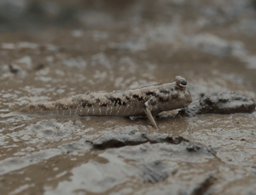
Atlantic mudskipper
For our last mud-loving example, we need to take a trip to the Atlantic Ocean, to the coasts of West Africa. The Atlantic mudskipper is a semi-aquatic fish that thrives around tidal flats, mangrove swamps, and mud. Have you ever heard of the phrase “fish out of water”, these creatures are actually fine with that! With a layer of mucus that prevents them from drying, and chambers within their gills to store water, the mudskipper has the ability to breathe out of the water. The ‘skipper’ part of their name comes from them using their pectoral fins to jump or ‘skip’ from area to area, while their pelvic fins are used to assist in crawling. Mudskippers are carnivores, ambushing their prey; a large variety including but not limited to worms, insects, crustaceans, and other small fish.