
Michigan History: Triassic period
Written by: Seth Bivins, naturalist at JNC
A past article explained why Michigan doesn’t have fossils from the Mesozoic era, which lasted from approximately 252 to 66 million years ago and is better known as the age of dinosaurs. Millions of years earlier, Michigan was underwater before uplifting events left it above sea level and exposed to the sun. Without plentiful mud to cover recently dead bodies, that made preserving fossils nearly impossible. Our state wouldn't be suitable for preserving fossils until the Ice Age.
So will this period of the past forever be missing? Short answer, yes. Paleontologists estimate that only 1% or fewer of all extinct animals fossilized. The long answer is that we can make an educated guess of what dinosaurs and relatives were living in Michigan based off surrounding areas. However, take this article with an extreme grain of salt.
Chapter one takes us to the Triassic period (approx. 252–201 million years ago). We know that Michigan was part of the supercontinent Pangea, which formed when all the continents were merged together from their tectonic plates mashing together. Pangea was a vast and dry inland desert with no polar regions. The center grew very arid and experienced seasonal shifts between hot summers and cold winters. Spread out were the occasional forest and river habitats, but with all the landmasses of the planet merged together, few if any of these rivers reached the interior of Pangea. We know through certain fossils that several families of animals were widespread as their remains have been found on multiple different continents.
The USA states closest to Michigan that have a fossil record of this time period, were Pennsylvania and New York. Notable residents of Pennsylvania during the Triassic were the crocodile like Centemodon and Compsosaurus. A close relative of these two, called Rutiodon, was found in New York. These three crocodile fakers belonged to a group of animals called the Phytosaurs. Fish and small reptiles were also found in formations in these two states. We can infer that the areas around Michigan were patches of fresh water river systems and a welcomed sight to any Triassic animals that travelled across the desert. In Canada and various USA states was a strange animal called the Hyperodapedon, which was a seed eating herbivore that is one of the most widespread animals in the world. These Hyperodapedons have been found with bite marks from Phytosaurs. It is possible that some species of Hyperodapedons could have travelled through Michigan’s deserts, and risked travelling through Phytosaurs infested rivers as part of a migration, or to find food and water.
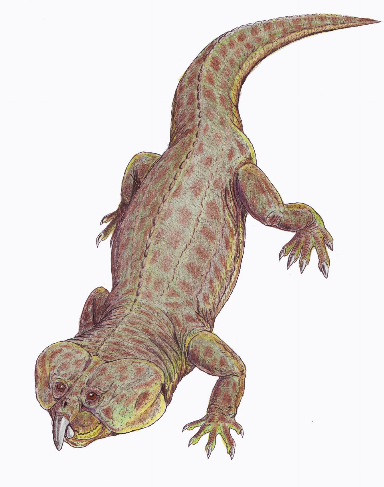
Hyperodapedon
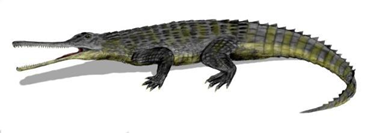
Phytosaurs